必要条件分析 (NCA) 与 企业声誉模型
项目简介
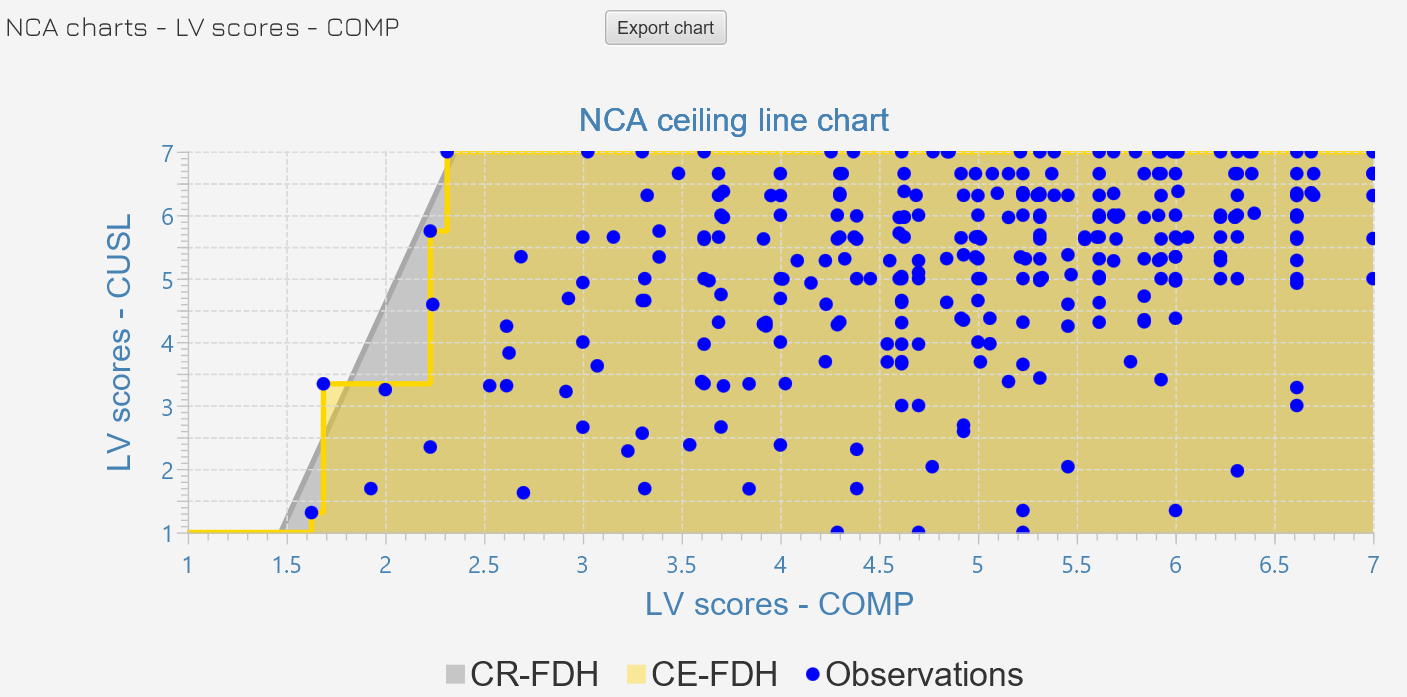
本示例项目包含基于企业声誉模型 (Eberl & Schwaiger, 2005; Schwaiger, 2004) 必要条件分析 (NCA) (Dul, 2016; Dul, 2020) 示例——另一 Hair 等 (2022) 和 Hair 等 (2024)。数据 (344 个观测值) 来自德国手机行业。如 Hair 等 (2024)、Richter 等 (2020) 和 Richter 等 (2022) 所述,PLS-SEM 生成的构念得分用于构建结构模型中构念间关系的回归模型。基于这些回归模型,SmartPLS 支持 NCA 分析。
参考文献
Dul, J. (2016). Necessary Condition Analysis (NCA): Logic and Methodology of "Necessary but not Sufficient" Causality. Organizational Research Methods, 19(1): 10-52.
Dul, J. (2020). Conducting Necessary Condition Analysis. Sage: London.
Eberl, M. & Schwaiger, M. (2005). Corporate Reputation: Disentangling the Effects on Financial Performance. European Journal of Marketing, 39(7/8), 838-854.
Hair, J.F., Hult, G.T.M., Ringle, C.M., & Sarstedt, M. (2022). A Primer on Partial Least Squares Structural Equation Modeling (PLS-SEM), 3rd Ed., Sage: Thousand Oaks.
Hair, J.F., Sarstedt, M., Ringle, C.M., & Gudergan, S.P. (2024). Advanced Issues in Partial Least Squares Structural Equation Modeling (PLS-SEM), 2nd Ed., Thousand Oaks, CA: Sage.
Richter, N.F., Schubring, S., Hauff, S., Ringle, C.M., & Sarstedt, M. (2020). When Predictors of Outcomes are Necessary: Guidelines for the Combined use of PLS-SEM and NCA. Industrial Management & Data Systems, 120(12): 2243-2267.
Richter, N.F., Hauff, S., Ringle, C.M., Sarstedt, M., Kolev, A., & Schubring, S. (2023). How to Apply Necessary Condition Analysis in PLS-SEM. In J.F. Hair, R. Noonan & H. Latan (Eds.), Partial Least Squares Structural Equation Modeling. Springer: Cham.
Schwaiger, M. (2004). Components and Parameters of Corporate Reputation: An Empirical Study. Schmalenbach Business Review, 56(1), 46-71.